Showing posts with label sculpture. Show all posts

Friday, June 6, 2014

Spring Hats! The cutest kindergarten art project in the world.

Kindergartners begin a sculpture unit by making cylinder and raindrop paper sculptures.  We move into working with Model Magic, and end with a wearable art hat!  I love to teach this at the end of the school year, and I love to see the kindergartners walking around wearing these adorable hats.  
Kindergartners folded the hats by themselves step-by-step out of 18x24" construction paper.  We talked about things that you see in spring and started by adding grass to the bottom of our hats.  I provided paper and instruction on making stems, leaves, and flowers, but I left the execution of the decorations to them.  In total it took us 1.5 hours.  The best is seeing a class filing out for the day with their hats on!


Friday, May 16, 2014

Awesome Owls, lesson 2 and a change in plans (life on a cart!)

For our third day of Awesome Owls, first graders made a small owl out of Model Magic.  I got the idea from Pinterest!  I thought it would be a nice way to review and reinforce our theme.  First grade would have the chance to learn about and make sculpture, and we got to discuss real vs. implied texture.

When I packed up my cart, I included navy blue 9 x 12" construction paper, yellow squares, and black strips.  The idea was that students would use the navy blue as their placemat, then use it as the background for a constructed home for their clay owl.  I pictured a black tree silhouette and a yellow moon.  I even thought about how I would teach making the tree... V's and Y's..V's & Y's! I wasn't prepared for when I asked the first graders where their owl would live.  First student said a tree, a second said a nest, then they started getting creative. "A house, like a real house with a TV!" "underground!" "my bedroom!"  "a house IN the tree!"  So, I scrapped my step-by-step boring construction of a tree and moon, and let the kids draw whatever kind of habitat they wanted with pencil.  We traced with Sharpie and colored with regular crayons Had I been in my classroom I would of used color sticks, or construction paper crayons, however the regular crayons gave it a nice dark night feeling.  First graders understood that their owls are most active at night.


Thursday, April 17, 2014

Model Magic Pinch Pots in Second Grade


If you need a project that will take 5 minutes, this is it.
I do not have a kiln, or a classroom, but I still try to do additive and subtractive sculpture projects with each of my classes every year.  Model Magic is not a cheap option, but it is clean and easy.
I opened a 1/2lb. package of Model Magic.  Using my teacher scissors, I cut it in half longways, then in half on the short side.  I continued dividing the clay in this way till I had 16 small pieces.  I tossed them in a zip-loc.
Students received a disposable lunch bowl and wrote their name in the bottom.  We discussed the rules of the clay (no throwing, tossing, or pulling apart).  I gave each student a piece to roll into a sphere.

Step-by-step I took them through making a pinch-pot.  Like I said, 5 minutes tops.  They put their little bowl in their lunch tray and we set them to dry.  I came in to their room later in the afternoon and wrote their names on the bottom with Sharpie once they were dried a little.

Week 2, we used patterns and Sharpie and decorated our pots.

Wednesday, April 16, 2014

Not quite Native American Kachina Dolls in Second Grade.

I sometimes cringe when I see a display of brightly painted African Masks, or paintings of patterned Native American scenes, but, I've also been able to fine validity in my own teaching of multicultural art.

Second grade's not quite Native American Kachina dolls is an example of this.  We started with deep learning of the Hopi Native Americans.  We watched YouTube clips of real Native Americans discussing their craft and the meanings behind their sacred art.  We visual analyzed several pieces, and applied this art to history. Second graders already understood the meaning of Kachina dolls, and why they were so important to the Hopi before they embarked on their own doll.

Students did not copy a Hopi Kachina, rather, they thought about something very important to them and designed from there.  Their stuffed dolls now hang in the hall.


The Art of Education just recently published a blog post on this same topic.  It mirrors my sentiments to a tee.


Thursday, April 10, 2014

Cylinders and Raindrop sculptures with Kindergarten

Paper Quilled Hanging Sculptures is a lesson plan given to me by a colleague many years ago.  The lesson seems simple enough... and it is!  I teach this lesson every year and I always get fabulous results.

I introduce the lesson with photos of various types of sculpture.  We talk about abstract and figurative sculpture and what makes these different than a painting or drawing.  This lesson introduces a lot of great vocabulary too; height, width, depth, 3D vs. 2D, form, and cylinder.  I also like to demonstrate holding a sculpture in my hand and seeing it from all views, or walking around or under a giant sculpture.

Sometimes we hang our sculptures, other times I attach them to matte and hang them on the wall, sometimes they are meant to just sit on a shelf.  Every variation works.  I've even added puff ball spheres, and rectangular prisms at times.

This lesson works great for a substitute too!

Wednesday, April 2, 2014

Art on Parade! Fifth Grade makes their own version of Chicago's Cows on Parade!

My husband owns a music store and my father-in-law does all the guitar repairs that come in.  Occasionally there is a guitar that is just not worth fixing.  That's where art class comes in.

I collect the old useless acoustics, basses, cases, and ukuleles for a project I call Art on Parade.  Similar to Chicago's 1999 Art Exhibition "Cows on Parade,"  Art on Parade asks fifth graders to choose a theme, and turn an old instrument, box, or board into a fabulous work of art.        
I even got the custodian to mount a guitar hook behind my desk to show off the guitars ready to be turned into masterpieces!

We started by discussing "Cows on Parade."  My classes went through a slideshow that included a few news broadcasts about the event as well as a slideshow featuring nearly all 300+ cows that were in Chicago.

We also discussed WHY? these cows were so special in Chicago, and what was the draw of seeing artistic cows.

Then students had a chance to brainstorm.  They could work in teams or alone to complete their project.  At this point, they didn't know what their final media would be. Once they established themes and groups, (I said they could work in groups of up to four) the raffle for what their final project would be on began.
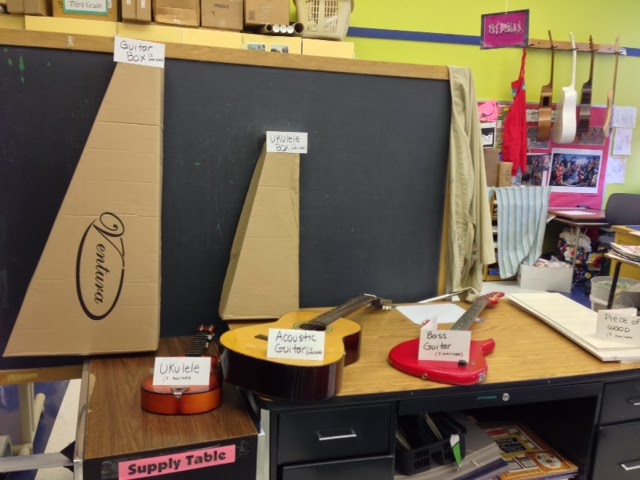
I put their choices on display so they could decide what they wanted most.

Students had to choose their 1st - 5th choice -

Acoustic Guitar
Bass Guitar
Ukulele (or Mini Guitar)
Guitar Box
Uke Box
Piece of Wood
Guitar Case
Or other.... (they would have to tell me if they had a different idea)

Once all the tickets were collected and put in their boxes, the drawing began.


I divvied my collection up by class, so my later afternoon class would have as much chance of getting to decorate a Bass as my morning class.  In total I had 3 Acoustic Guitars, 1 acoustic bass, 2 electric Basses, 2 Ukes, 2 Guitar boxes, 2 Guitar cases, 7 Uke boxes, and 9 pieces of wood from an old book shelf that fell apart.  Of course the kids were most excited about the guitars.  However, the pieces of wood were also a big draw.  This lesson could be modified with so many different everyday objects.  I was teaching high school during the time of the original "Cows on Parade" and we made plaster casts of our heads and hands on parade!

The students witnessed the selection process and most were fine with what they got.  A few students became unhappy with their group, because they realized only one student would be able to take the project home!  I gave them the option of going separate, or donating their project to the raffle at the end of the year art show.  Other students did not quite follow directions on the raffle paper!  No Names!  Unreadable choices!  Too many entries!  Those students were basically disqualified and given a box (the least popular choice, and what I had leftover).        

I created a series of sketchbook pages depending on what the student would be designing.  They have an outline for the students to design and say:
You have already come up with a theme for your “Art on Parade” project.  How will
you design your guitar, bass, ukulele, guitar case, box, or wooed/paper within that theme?  You can draw, paint, construct, collage, use textiles, found objects, magazines, or anything else you can think of! This is a 3D work of art. Be sure to consider all the sides. 

Here is each page:
Guitar or Ukulele
Guitar Case
Electric Bass
Guitar or Ukulele Box
Wood/Paper

Next students got to work!  Some primed, some didn't.  I left the options and media completely up to them.  I would give a few suggestions here and there, but I really wanted students to problem solve on their own.  I told them several times I had a ton of supplies and whatever they needed, let me know and I can get it out.  I had a few kids ask for something specific, but most went with the paints and markers that I had available.


We spent two hours working on our actual finished product.  The kids did great and I could tell they enjoyed all the independence.

When students were finished they reflected on their work with a simple question/answer page.

Saturday, August 31, 2013

Bas-relief, sculptural Family Portraits - with handouts! Age level: Intermediate


Family Portraits

Principle: Unity
Mixed Media
Elements of Space & Form

Plain and simple, this lesson began as a way for me to meet a state goal.  I had to come up with a way for my students to turn a two-dimensional drawing into a three dimensional work of art.  As the lesson developed, however, greater goals were achieved and a more successful work of art was accomplished.

I am always trying to make a connection with my students.  Like most elementary art teachers, I only get to see my students for one small morsel per week. Unlike a classroom teacher trying to get to know only one class, we are trying to get to know several classes.  When you are new to a district, or a student is new, it may take a few semesters before you can forge a meaningful bond with a student.  You also have so many students that finding something in common, or sharing a funny story with each one is hard to do.  This was something that unexpectedly occurred with this project. 
At the beginning of this lesson, we looked at examples of family portraits that are prevalent throughout art history. We explore bas-relief from ancient Greece, to the moody serene depictions of Rembrant’s own family, and to more current translations by Jacob Lawrence.  As a class we discussed the artist’s relationships in the paintings, as well as how they are similar and different to our own.  This opened up the door to sharing about our own families.  I did want to learn more about my students and their lives and families.  I shared about my life and family as well.  They learned about my husband and daughters and dog, and they learned that when I was their age I lived with my mom, brother, and sister because my parents were divorced.  I remembered thinking when I was in school that I was the only kid who had a family like that, so I knew some of my students must of felt that way too.  I didn’t want to draw attention to that, but instead show that I can relate.  The conversations about our families led to a lot of fun anecdotes and art class bonding.

Next, we discussed the principle of design unity before we began our sketch, and how important it is to keep our family members in proportion to one another.  I would draw examples on the board of a gigantic mom next to a puny four year old, or an eleven year old with a giant head next to a dog bigger then them.  We also discussed the element of space and how important our backgrounds are.  Where should our horizon line be? Are the people inside or outside?  Is this a place the family really goes or is it from your imagination?  We brainstormed out loud and drew different combinations.  No one is allowed to draw a straight horizon line with a corner sun, tree with a squirrel hole, and “m” birds.  My class knows that has been drawn way too many times before!  The compositions of family members the students came up with were fantastic.  I have seen all sorts of pets included too from iguanas to goldfish and families spanning several generations. The sketch was very important and we spent a lot of time on it.
When a final sketch was complete and colored, our next problem was to translate that sketch into a mixed media bas-relief sculpture.  The students make their people out of soft air dry clay. We keep the clay in one sausage like piece, and pull the head, arms and legs out of the clay.  This keeps the clay from breaking so easily once it dries.  They paint the pieces and use fabric and yarn scraps to dress their family.  The backgrounds are sturdy pieces of matte board. The students are given free reign over a variety of supplies to complete an environment for their family.  I demonstrate and give ideas on how they could complete the backgrounds, but it is really up to the students to be as creative as possible in how they complete the task and assemble their sculpture.

Another delightful turn of events with this project was the time and effort it took to assemble the sculptures and the creativity the students put forth in their creations.  It made me realize I had been hung up on “meeting goals,” I had forgotten how important the process was.

Objectives
Students will:
  • Demonstrate the same idea in 2D and 3D media.
  • Create, color, dress, and assemble their family in an imaginative way.
  • Do quality work.


Materials
  • 9” x 9” white drawing paper
  • pencils and erasers,
  • extra fine point permanent markers
  • colored pencils, markers
  • 9” x 9” matte board
  • soft air dry clay
  • glue
  • tempera paints & brushes
  • fabric & yarn scraps
  • textured paper scraps
  • found objects


National Visual Art Standard
Students use different media, techniques, and processes to communicate ideas experiences, and stories


Thursday, August 29, 2013

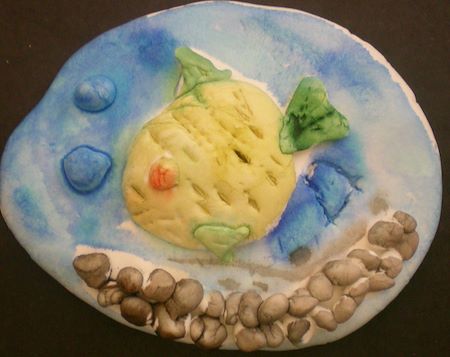
Bas-Relief Fish Bowl in Model Magic - Pre K to first grade


Materials
Pencils
Sketch paper
Soft Air Dry Clay (Model Magic)
Modeling tool or Plastic Knife
Watercolor Paint
Brushes
Water cups
Tempera Varnish

Procedure
1.  Discuss creatures that live under the sea.  Together, using basic shapes, draw many sea creatures and fish found in the ocean.  Show photographs and fine art featuring sea creatures and show students examples of sculpture and bas-relief sculpture. 
2.  Each student should receive about 1oz. of soft air dry clay.  Students should quickly rip their chunk in half and roll each chunk into a sphere. Have students take the larger of the 2 spheres and flatten it into a pancake using the ball of their hand.
3.  Using the modeling tool or the plastic knife, students will slice off the top of the pancake to make a fish bowl.
4.  Take the sliced off portion (the top of the circle) and start tearing it into a bunch of small pebbles. Once they have a small pile, they may attach them to the bottom of their “bowl.”  The soft clay will attach without hatch marks, slip, or glue.  Students will just need to press firmly. 
5.  The second sphere will then be flattened into a pancake.  Using the modeling tool or plastic knife they will gently scratch their fish or sea creature on this pancake. If necessary, demonstrate on the board how to draw a simple fish using ovals, triangles, and circles. The students will cut the fish out and reshape it onto the surface of the bowl.  Using the rounded edge of the modeling tool students may add texture to their fish to show scales.  The extra soft clay may be used to add plants or bubbles or more fish!

6. Once fish bowls have air dried, students will stain their fish bowls with watercolor paints.
7. Finally, a coat of tempera varnish to the entire front side of the bowl will make the bowl shine!

Saturday, July 27, 2013

Family Portrait Worksheet and Sculpture Handout

Family Portrait Worksheet and Sculpture Handout helps introduce students to family portraits as a subject matter.  Page two introduces students to bas relief sculpture and new media and techniques they could use

Monday, July 8, 2013

Ancient Egyptian Sarcophagus worksheet

I have been finding a bunch of old brainstorming worksheets, vocab pages, and other resources deep in the belly of my file cabinets.  Some of these are so old, the original file no longer exists...or is on 3.5 inch floppy!

This Ancient Egyptian Sarcophagus Worksheet was used to introduce a sculpture project and integrate with fourth graders study of Ancient Egypt.

Friday, May 24, 2013

Michelangelo and the Mixed-Up Files of Mrs. Basil E. Frankweiler.

 One fifth grade class was finishing off the year by reading From the Mixed-Up Files of Mrs. Basil E. Frankweiler by E.L. Konigsburg with their classroom teacher.  The story is about a brother and sister who run away from home and live in the Metropolitan Museum of Art.  While there, they try to uncover a mystery regarding a beautiful new angel sculpture the museum has acquired.
The fifth grade teacher asked if I would be able to integrate an art lesson with the book.  I remember liking the book as a kid, (it was published in 1967!) I reread it one weekend to see what I could do in art class.
One focus in the story is on the art of Michelangelo whom the children believe may be the true artist of a mysterious angel sculpture.  While I read I envisioned Michelangelo's Pieta.  The smooth and shiny marble and the delicate fluidity of the sculpture are how I pictured Angel.  I began the art lesson by showing my class a photograph of the Pieta.  The class was mesmerized.  Several students commented that it was the most beautiful sculpture they had ever seen.  Several remarked on the subject matter, yet were surprised at how pretty it was.  I love when the students have aesthetic experiences!
Next, we read a little about the life and work of Michelangelo.  I used a biographical handout for us to discuss.
The class again integrated what we had learned in the book and brainstormed ways art historians figure out who made ancient or old works of art.  We wrote several ideas on the board.  Some suggestions were; the artists style, photography (photos of the artist at work), literature about the artist, the artists notes or diaries, passed down verbal stories, or combinations of all these small clues.
I asked the students to write down something about themselves that would give people a clue as to who they were if they were kept anonymous.  This was fun.  Some of the students I could guess what they were going to write.  Like the girl who loves cats, or the boy who is Minecraft obsessed.  And sure enough - that was what they wrote.
Each student received two small smooth stones.  Using the clues about themselves as their theme, they were going to decorate their rocks.  We used Sharpie Marker and acrylic paint markers.  When the designs were done we varnished them with tempera varnish.
Finally, the fun part.  We took a walk around the block and hid our stones.  Our hope was that somebody, a stranger perhaps, might find the stone and wonder about the artist.  Maybe even be able to figure out who it is!  Some students were not keen on hiding their stone because they loved it so much, so I let them save one to take home!
This lesson was a lot of fun and I hope I get to do it again soon!